
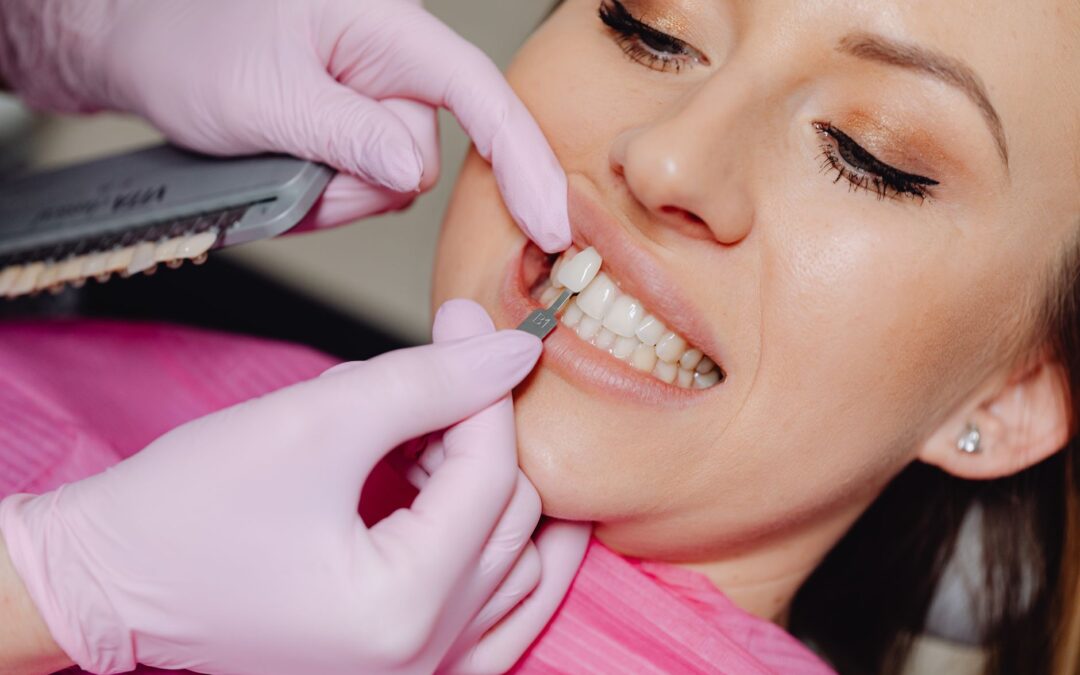
Taylor Swift has been photographed more than almost anyone alive, which means her smile has been scrutinized from every angle, at every age. Lately, searches for “does Taylor Swift have veneers” and “Taylor Swift veneers” have been climbing sharply, and it is a genuinely interesting question, because the answer is less dramatic than people expect, and the real story is a useful one for anyone thinking about their own smile. Let’s look at what we can actually observe, what cosmetic dentistry likely did (and didn’t) play a role, and what any of this means if you’re considering a smile update of your own.
What Side-by-Side Photos Actually Show
Compare Taylor Swift’s smile from her early country era: roughly 2006 to 2009, with photos from the past few years and you’ll notice a few things. Her teeth are noticeably whiter and more uniform than they were at 16 or 17. The slight size variation in her upper laterals (the teeth just beside the front two) has evened out. The overall shape looks a little more symmetrical and polished.
None of that is conclusive proof of anything. A teenager’s teeth change shape naturally as the face matures. Professional teeth whitening alone can transform a smile dramatically. And orthodontic work (invisible aligners, retainers) can shift teeth into better alignment without touching the surface at all.
That said, the brightness and uniformity of her current smile are consistent with either high-quality professional whitening over many years, a small number of veneers on the most visible upper teeth, or both. Dentists who have commented publicly on celebrity smiles generally land in the same “probably some professional whitening, possibly a few conservative veneers” range, and they’re working from photos, just like everyone else. No one outside her dental team actually knows.
What’s notable is what her smile doesn’t look like. It doesn’t have the “piano keys” uniformity (every tooth the same width, the same height, the same blinding white) that marks an aggressive full veneer set. If she has had cosmetic work, it reads as tasteful and conservative: enhancing her natural smile rather than replacing it.
The Difference Between a Conservative Veneer and a Full Smile Makeover
This is where the real patient-education value lives, because “veneers” gets used as a catch-all term that covers an enormous range of treatment.
At one end of the spectrum: a single composite veneer placed on one chipped tooth in a single appointment. At the other end: a full-arch porcelain veneer set covering 10 to 14 upper and lower teeth, each tooth prepared (meaning a thin layer of enamel is removed) to make room for the porcelain shell. The second option is permanent: once that enamel is gone, you will always need some form of veneer or crown on those teeth. That is not inherently a bad thing, but it is a significant commitment, and it should be made with clear eyes.
In between those two poles are the options most people actually end up choosing:
- A few porcelain veneers on the most visible teeth, often just the upper front six: to address discoloration, minor chips, or small shape irregularities while leaving the rest of the smile alone.
- Composite (tooth-colored resin) veneers, which require little to no enamel removal, can be placed in a single visit, and cost significantly less, though they typically last 5–7 years versus 10–20 for porcelain.
- No-prep or “prepless” veneers (Lumineers are the best-known brand) for cases where the existing teeth are small enough or the desired change modest enough that no reduction is needed at all.
Professional whitening (either in-office or with custom take-home trays) can also accomplish a surprising amount on its own, especially when the main goal is brightness rather than shape or alignment. A lot of celebrity smiles that people assume required veneers are actually the result of whitening plus good orthodontics from earlier in life.
The “Turkey Teeth” lesson: The viral backlash against the British trend of getting aggressive, heavily prepared full-arch veneers (often abroad, often cheaply) is a useful reminder that more is rarely better in cosmetic dentistry. The goal is a smile that looks like a healthier, brighter version of you, not a uniform dental appliance. A good cosmetic dentist will tell you the most conservative path to your goal, not the most comprehensive one.
What Actually Changes a Smile Most, and It Might Surprise You
Here’s a fact that gets lost in the veneer conversation: alignment matters more than whiteness to most people’s perception of a “great smile.” Crooked or crowded teeth that are bright white still look crooked. Straight teeth that are a few shades off-white look healthy and attractive. Orthodontic treatment, whether traditional braces or Invisalign clear aligners, often delivers a more dramatic improvement than whitening or veneers, with no enamel reduction and results that are genuinely permanent (with a retainer).
The most effective cosmetic outcomes our dental team sees come from a logical sequence: fix alignment first if needed, then whiten, then address individual teeth that still bother you. That sequence is also the most conservative and the most cost-effective.
When veneers do make sense, modern porcelain is genuinely impressive. It can address color, shape, length, and minor spacing in a way that looks completely natural, reflects light the way real enamel does, and holds up well over time. The key is that the design should be driven by your facial proportions and your natural smile, not by a celebrity’s photos.
Can You Get Cavities Through Veneers? (Yes, This Is a Real Question)
“Can you get cavities with veneers” is also trending right alongside the Taylor Swift searches, and it’s a smart question. The short answer: yes, absolutely.
A veneer covers the front face of a tooth, but the tooth underneath is still alive (for porcelain veneers) or still exposed at the edges and back. If plaque accumulates at the gumline or between teeth, the underlying tooth can decay. People who have veneers sometimes fall into the mental trap of thinking their “covered” teeth are protected: they’re not. Brushing, flossing, and regular cleanings matter just as much after veneers as before, arguably more, because repairing decay under a veneer is more complex than fixing a cavity on an untreated tooth.
This is one of the reasons our office emphasizes that cosmetic dentistry in South San Francisco starts with a healthy foundation. Placing veneers on teeth with active gum disease or decay isn’t just inadvisable: it’s setting the patient up for failure down the road. Before any elective cosmetic work, we make sure the underlying oral health is solid.
What a Consultation Actually Looks Like
If you’re curious about whether cosmetic work might be right for you, whether that’s a single composite touch-up, professional whitening, a few porcelain veneers, or a more comprehensive plan: the starting point is a conversation, not a commitment.
At Vaksman Dental Group, our dentists use digital imaging and, where relevant, our Pearl AI system (an FDA-cleared AI tool that reviews X-rays to help catch underlying issues that might not be visible on the surface) to get a clear picture of your current oral health before any cosmetic discussion begins. That matters, because the best cosmetic plan is one built on a healthy foundation, not layered over problems that haven’t been addressed yet.
If veneers come up as an option, our team walks through the full picture: how many teeth, what material, how much prep is involved, what the maintenance looks like, and what it costs. National ballpark figures (not our office’s specific pricing) typically run $900–$2,500 per tooth for porcelain veneers and $250–$1,500 per tooth for composite veneers, depending on the complexity and the provider. A realistic conversation about your goals and budget is always part of the process.
For a deeper look at the veneer decision, including when crowns make more sense: our post on veneers vs. crowns covers the comparison in detail.
The Bottom Line
Did Taylor Swift get veneers? Probably some combination of professional whitening and, at most, conservative cosmetic work on a handful of teeth, though only her dental team knows for certain. What’s more interesting than the gossip is what her smile actually illustrates: when cosmetic dentistry is done well, you can’t really tell it happened. It just looks like a great smile.
The lesson for anyone considering their own cosmetic work is the same: start with your oral health, be clear about your goals, choose the most conservative path that gets you there, and work with a team that will tell you what you actually need, not just what’s most profitable to sell. That’s the conversation we’re always happy to have.
According to the American Dental Association’s MouthHealthy resource on veneers, veneers are a long-term commitment that requires careful patient selection and realistic expectations, which is exactly the framing we’d encourage anyone considering them to bring into their first consultation.
Frequently Asked Questions
Did Taylor Swift actually get veneers?
No one outside her dental team can say for certain. Side-by-side photo comparisons show her smile has become whiter and more uniform over the years, which is consistent with professional whitening, conservative cosmetic dentistry, or both. Her smile does not display the telltale signs of an aggressive full veneer set: it reads as natural and proportionate to her face.
Can you get cavities if you have veneers?
Yes. Veneers cover the front face of a tooth, but the underlying tooth structure and the areas at the gumline and between teeth remain exposed to plaque and decay. Regular brushing, flossing, and professional cleanings are just as important, if not more so: after getting veneers.
Are veneers bad for your teeth?
Porcelain veneers require the removal of a thin layer of enamel, which is permanent and irreversible: the tooth will always need coverage after that point. This is not inherently harmful, but it is a significant commitment. Composite veneers and prepless options involve little to no enamel reduction. Whether veneers are appropriate depends on your individual situation, and a good dentist will recommend the most conservative option that achieves your goals.
How much do veneers cost?
As a national ballpark (not Vaksman Dental Group’s specific pricing), porcelain veneers typically range from $900 to $2,500 per tooth, while composite veneers range from $250 to $1,500 per tooth. Total cost depends on how many teeth are involved, the material selected, and the complexity of the case. Most dental insurance does not cover elective cosmetic veneers. A consultation is the best way to get an accurate estimate for your specific situation.
Curious whether cosmetic dentistry could work for your smile? Our team in South San Francisco is happy to walk through your options: no pressure, just an honest conversation.
Written by the Vaksman Dental Group team and medically reviewed by Dr. Irena Vaksman, DDS, South San Francisco.