
MrBeast’s result is bright, dramatic, and impossible to miss. Haerin’s is subtle, natural-looking, and barely detectable unless you’re comparing old photos side by side. Neither approach is wrong. But one of them is probably right for you, and understanding the difference could save you from an expensive regret.
Here’s a straightforward breakdown of what we know, what the two approaches actually involve, and how to think about your own decision.
MrBeast vs. Haerin: The Veneer Comparison at a Glance
| MrBeast-Style (High-Impact) | Haerin-Style (Natural/Subtle) | |
|---|---|---|
| Visual goal | Maximum brightness, uniformity, Hollywood-white | Polished but believable; looks like naturally great teeth |
| Shade | BL1 or similar ultra-bright white | A-1 or slightly warmer — matches natural tooth color |
| Veneer type most common | Traditional porcelain (Emax or layered), sometimes full-coverage | Emax or feldspathic porcelain, often with minimal prep |
| Tooth prep required | Usually yes — enamel is reduced to create space for thicker, whiter shells | Minimal-prep or prepless possible, depending on tooth position |
| Reversibility | Not reversible once enamel is reduced | Partially reversible with prepless; still permanent with any enamel removal |
| Who it suits best | On-camera personalities, performers, those who want a bold statement smile | People who want improvement without anyone knowing they had work done |
| Risk of looking “fake” | Higher — requires skilled lab and dentist to stay in bounds | Lower — natural shading and translucency mask the work |
| Typical number of teeth | 8–12 upper (sometimes lower too) | 6–10 upper, depending on “smile zone” |
| Longevity | 10–20 years with good care | 10–20 years with good care |
| National ballpark cost (not our office prices) | $1,200–$2,500 per tooth | $900–$2,500 per tooth (prepless sometimes at lower end) |
Cost ranges above are national estimates only and do not reflect Vaksman Dental Group’s pricing. Ask our team for an in-office consultation to get accurate numbers for your specific case.
The High-Impact Approach: Bright, Bold, Camera-Ready
MrBeast’s smile transformation became one of the most-discussed dental makeovers in recent memory. The result is uniformly white, with symmetrical, full-looking teeth that photograph beautifully and look intentional from every angle. That’s not an accident — it’s a specific design philosophy.
What works about it
- Maximum visual impact. If your goal is a dramatically improved, unmistakably bright smile, this approach delivers. For people on video, stage, or in front of cameras, it reads well and holds up under bright lighting.
- Corrects multiple issues at once. Discoloration, chips, gaps, minor misalignment, and shape irregularities can all be addressed in one treatment plan. No need to layer multiple cosmetic procedures.
- Predictable outcome. Because the lab is working with a defined shade target and more surface area, color matching across all teeth tends to be very consistent.
What to watch out for
- The “chiclet” risk. Ultra-white, overly uniform veneers on teeth that weren’t properly sized or shaped for the patient’s face can look artificial — what people sometimes call a “fake” smile. This is almost always a communication or technique issue, not an inherent flaw of veneers themselves. The right dentist and the right lab make all the difference.
- Enamel reduction is permanent. Getting this look almost always means removing a layer of enamel so the ceramic shell doesn’t sit too far forward. Once that enamel is gone, you’re committed to veneers for life.
- Sensitivity post-procedure. Some patients experience temporary tooth sensitivity after prep, though it usually settles within a few weeks.
- Higher maintenance expectations. Staining from coffee and wine is less of a risk with porcelain than with natural teeth, but ultra-white shades show any change more noticeably. Consistent oral hygiene matters more, not less.
The Subtle Approach: Look Like You Were Born With It
Haerin’s smile has attracted a lot of attention precisely because it doesn’t look like veneers at all. The result appears to be a slightly more perfect version of her natural teeth — a few shades brighter, with smoother edges and better proportions, but nothing that screams “dental work.” This is increasingly what cosmetic dentistry patients ask for, and it requires a different set of priorities.
What works about it
- Natural translucency. Feldspathic porcelain and well-crafted Emax veneers in natural shades can mimic the way real enamel catches light. The result looks alive, not plastic.
- Less invasive options exist. For patients with reasonably positioned teeth who mainly want to address color, minor chips, or slight shape irregularities, prepless or minimal-prep veneers are sometimes possible. Less drilling means less permanent change.
- Versatile age range. Younger patients especially tend to prefer this look — it ages well and doesn’t announce itself at a job interview or first date.
- Still genuinely transformative. “Subtle” doesn’t mean “minor.” A well-executed natural veneer set can dramatically improve a smile while looking completely authentic.
What to watch out for
- Harder to achieve if your teeth are very dark. If underlying tooth color is significantly stained or dark, very natural-shade veneers may not fully mask it. A slightly thicker or brighter shell may be needed, which brings more prep back into the picture.
- Less forgiving of gaps or major misalignment. Natural-looking veneers work best on teeth that are already reasonably positioned. For significant alignment issues, Invisalign first may produce a better long-term result.
- Not a one-size fit. “Natural” is relative to your face, skin tone, and age. A shade that looks natural on one patient can look off on another. This is where mockups and digital smile design tools are genuinely useful.
Which Approach Is Right for You?
This is where the real conversation happens — and it’s one our dental team has with patients regularly. There’s no universal right answer, but a few questions tend to clarify things quickly.
You might prefer the high-impact approach if:
- You’re on camera, on stage, or in high-visibility situations regularly
- Your teeth have significant discoloration that lighter-shade veneers won’t fully mask
- You want an unmistakable smile upgrade and you’re fully comfortable with that being visible
- You’re also addressing multiple structural issues (chips, gaps, size differences) at once
You might prefer the subtle approach if:
- Your goal is improvement that people notice but can’t quite place (“Did you do something? You look great.”)
- You want to preserve as much natural tooth structure as possible
- Your teeth are mostly healthy and well-positioned, just needing refinement
- You’re newer to cosmetic dental work and want a less dramatic starting point
What if you’re not sure yet?
That’s completely normal, and it’s one reason a consultation matters so much before any work begins. Many practices now offer digital smile previews — a way to see a mockup of different outcomes on your actual teeth before committing to anything. Our team at Vaksman Dental Group walks through exactly this kind of goal-setting conversation so the result feels like you, not someone else’s smile pasted on.
If alignment is part of the picture alongside cosmetic goals, it’s also worth considering whether Invisalign first could set your teeth up for veneers that need less prep and look more natural. And for cases involving chips, minor gaps, or color differences where veneers feel like too big a step, cosmetic dental bonding in South San Francisco is a reversible, lower-cost option worth discussing.
A Word on Choosing the Right Team
Both the MrBeast result and the Haerin result look the way they do because of skilled execution — not just the material or the shade choice. Veneers are one of the more technique-sensitive cosmetic procedures in dentistry. The prep depth, the impression or scan accuracy, the communication with the dental lab about texture and translucency, and the bonding technique all matter enormously.
The American Dental Association notes that veneers are considered irreversible in most cases, which is exactly why a careful, goal-focused consultation with a qualified cosmetic team is the right first step — not a same-day booking based on an online before-and-after.
At our South San Francisco office, we use digital tools and take the time upfront to understand what outcome actually fits your face, your lifestyle, and your preferences. That’s how you avoid ending up with someone else’s smile.
Frequently Asked Questions
Did MrBeast actually get veneers?
MrBeast (Jimmy Donaldson) has publicly discussed having dental work done, and his smile transformation has been widely covered. His result shows the characteristics of high-impact porcelain veneers: high-brightness shade, uniform shape, and full smile coverage. We have no knowledge of his specific treatment details, and this post does not speculate about his clinical records.
What kind of veneers did Haerin get?
Haerin’s dental work has not been officially confirmed in detail. What observers note is that her smile appears notably more polished compared to earlier photos, with a natural-looking shade and smooth contours consistent with well-crafted, minimal-prep veneers or possibly Emax shells in a natural color range. As with any public figure, we don’t claim knowledge of her specific treatment.
Are Emax veneers the same as porcelain veneers?
Emax is a brand name for a lithium disilicate glass-ceramic material, and it is one of the most popular types of porcelain veneer material used today. It’s valued for its combination of strength and translucency. So yes — Emax veneers are a type of porcelain veneer, just a specific, high-quality variety. Feldspathic porcelain is another type, known for slightly more natural light-scattering properties, though it’s somewhat more fragile.
How do I know which veneer shade is right for me?
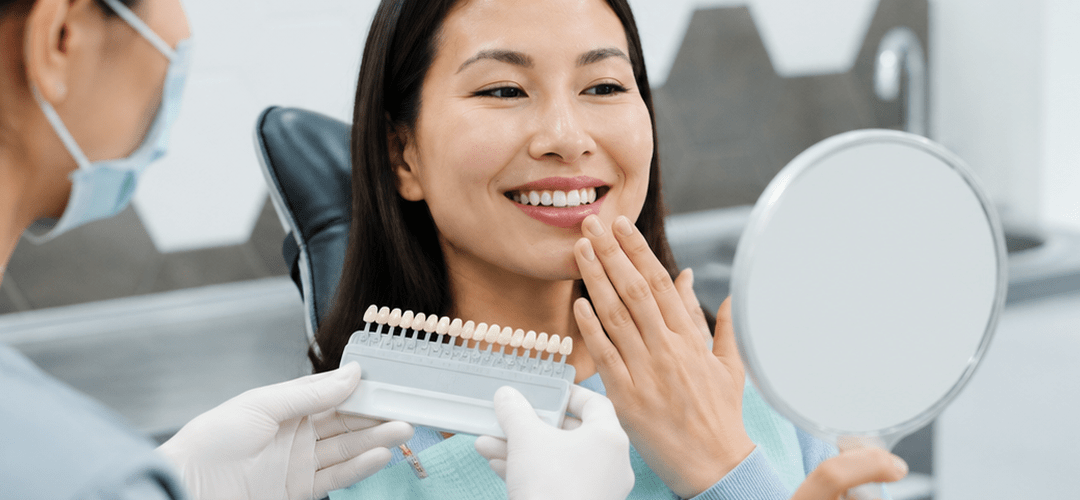
There’s no formula, but a few factors guide the conversation: your natural skin tone, eye color, age, and the shade of the teeth not being covered all influence what looks natural. Most cosmetic dental teams use shade guides and digital previews to help patients visualize options before any prep begins. A good starting principle: the whites of your eyes are often a useful upper limit for how bright a veneer shade can go before it starts to look artificial.
Schedule a Veneer Consultation
Written by the Vaksman Dental Group team and medically reviewed by Dr. Irena Vaksman, DDS — South San Francisco. Last reviewed July 2026.