
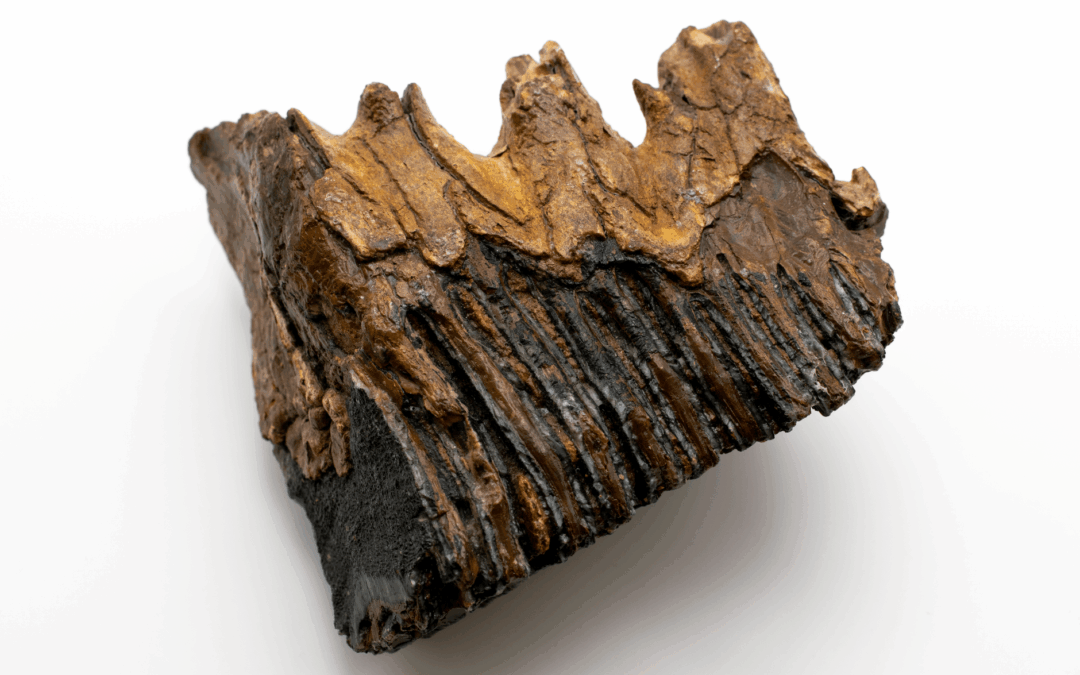
A “spectacular” fossilized mastodon tooth was recently discovered in a San Mateo County open-space preserve, and it turns out ancient teeth have a lot to say about modern ones. Enamel is enamel whether it formed 10,000 years ago or last year, and the clues locked inside that fossil connect directly to how you care for your teeth today.
- A mastodon tooth found locally in San Mateo County is a rare Ice Age find, and it made regional headlines for good reason.
- Mastodon teeth were built for grinding tough plant material, which is why the enamel ridges are so dramatic. Human enamel serves the same mechanical purpose.
- Paleontologists can read diet, age, and disease from fossilized teeth. Modern dentists read the same signals in your mouth at every checkup.
- Enamel does not regrow on its own in humans or mastodons. Protecting what you have is the only strategy that works.
- The find is a fun reminder that teeth are among the most durable structures in biology, and that keeping yours healthy pays off for a lifetime.
What Exactly Was Found, and Why Is It a Big Deal?
Reports from The Almanac and SFGATE describe the tooth as “spectacular,” found in a local open-space preserve right here in San Mateo County. Mastodon remains are rare on the West Coast. Most Ice Age megafauna fossils are found in the Central Valley or the famous La Brea Tar Pits in Los Angeles, so a local Peninsula find is genuinely unusual.
Mastodons (genus Mammut) were large, elephant-like mammals that roamed North America until roughly 10,000 to 13,000 years ago. They were not the same as woolly mammoths — mastodons had lower, more cone-shaped tooth cusps designed for browsing woody plants, while mammoths had the flat, ridged grinding teeth of a grass eater. That difference in tooth shape is how paleontologists tell the two apart in the field, often from a single tooth fragment.
The San Mateo County discovery is now being studied, and finds like this end up at natural history museums where researchers can extract information about ancient climates, migration patterns, and the animals’ health. Teeth, it turns out, are nature’s most information-dense fossils.
Why Do Teeth Fossilize So Well?
Bone is porous, which means it breaks down relatively quickly over geologic time. Enamel is different. It is the hardest biological material in the vertebrate body, made almost entirely of a tightly packed crystalline calcium phosphate mineral called hydroxyapatite. That density means enamel resists decomposition far better than bone, cartilage, or soft tissue.
The result: when paleontologists find a large mammal from the Ice Age, they are almost always finding it through its teeth first. Teeth preserve when nearly everything else dissolves. That is not just a fun fact. It is a direct signal about how valuable your own enamel is, and how costly it is to lose it.
According to the National Institute of Dental and Craniofacial Research (NIDCR), tooth decay remains one of the most common chronic conditions in humans. The irony is striking: enamel is tough enough to survive 10,000 years underground, yet it is still vulnerable to the acids produced by everyday bacteria in your mouth. The difference is that bacteria and dietary acids work on a timescale of months and years, not millennia.
What Can Teeth Tell Scientists (and What Can They Tell Your Dentist)?
Paleontologists treat a mastodon tooth the way a dentist treats your full set of X-rays: as a document full of information about the animal’s life. Here are a few things researchers can learn from fossil teeth — and the parallel for your own checkups.
Diet: Tooth shape and wear patterns reveal what an animal ate. Mastodons had tall, pointed cusps for puncturing and crushing leaves and branches. Mammoths had flat, ridged crowns for grinding grass. Your dentist sees wear patterns too: flat spots on your molars can suggest bruxism (nighttime grinding), and erosion on the backs of your front teeth can sometimes indicate acid reflux or frequent consumption of acidic foods and drinks.
Age: Teeth erupt in a predictable sequence. Researchers can estimate a mastodon’s age at death by which teeth were present and how worn they were. Your dentist uses the same logic — the eruption timing of wisdom teeth, for instance, helps confirm a teenager’s developmental stage.
Health events: Stress lines called “Wilson bands” or enamel hypoplasia can form in teeth when a young animal was sick or malnourished during tooth development. Those lines are visible on both fossil specimens and on modern human teeth. If you have ever been told you have “enamel defects,” a serious childhood illness may have briefly interrupted the enamel-forming process.
Isotopes and geography: The chemical makeup of tooth enamel preserves a record of the water and plants an animal consumed. Scientists use isotope ratios to trace where mastodons migrated. Researchers have similarly used isotope analysis of ancient human teeth to track migration and trade in archaeological populations.
At our office in South San Francisco, our dental team reads your teeth for many of those same signals at every exam: wear, erosion, decay risk, gum changes, and anything that looks like it needs attention sooner rather than later. The tools are more advanced than a rock hammer, but the underlying logic of “teeth tell stories” is exactly the same.
Enamel: Why “The Hardest Substance in Your Body” Still Needs Help
You have probably heard that enamel is the hardest substance the human body makes. That is accurate. On the Mohs hardness scale, enamel rates around 5, putting it in the range of steel. But hardness and invincibility are not the same thing.
Here is the catch: enamel has no living cells in it once it fully forms. Dentin (the layer beneath enamel) does contain living tubules, which is why exposed dentin causes sensitivity. But enamel itself is inert. When it is gone, your body cannot replace it. Mastodons dealt with this by having replacement molars — each one shifted forward as the previous tooth wore down, a bit like a conveyor belt. Adult humans get one set of permanent teeth and that is it.
The practical takeaway:
- Fluoride helps re-mineralize early-stage enamel softening before a cavity forms, but it cannot rebuild enamel once it is physically lost.
- Acidic foods and drinks (citrus, soda, vinegar-based foods) soften enamel temporarily. Rinsing with water after eating acidic foods is genuinely helpful.
- Grinding wears enamel faster than normal chewing, which is why a custom night guard can protect years of tooth structure.
- Once decay reaches dentin, a restoration (filling, inlay, or crown) is the only fix.
The Local Connection: San Mateo County’s Fossil Record
This mastodon tooth is not the first remarkable fossil find in our region. San Mateo County sits on the edge of the Pacific and has a rich late Pleistocene record, with prior finds including marine mammals and land megafauna. Open Space Authority preserves throughout the county protect not just wildlife habitat but the geology beneath it.
If you are curious about the find, local natural history organizations and the California Academy of Sciences in San Francisco regularly feature regional fossil discoveries. Finds like this one are typically transferred to institutions with the facilities to properly conserve and study them.
It is also a good excuse to appreciate something close to home: the Peninsula hills contain a record of life going back millions of years, and the teeth found in those hills are structurally similar to the ones in your own mouth right now.
What This Means for Your Dental Health (Practically Speaking)
The mastodon story is fun, but the oral-health message is concrete. Enamel is precious, irreplaceable, and surprisingly readable. Every checkup and cleaning is an opportunity for your dental team to catch problems while they are still small, the way a paleontologist reads early stress lines in a fossil before they become fractures.
A few habits that protect enamel for the long run:
- Brush twice a day with fluoride toothpaste. Fluoride is the best evidence-based enamel protectant we have, per the CDC’s oral health resources.
- Limit sipping acidic drinks throughout the day. Constant acid exposure keeps enamel in a softened state for hours.
- Address grinding early. A dental mouth guard can preserve decades of enamel you would otherwise slowly wear away.
- See your dentist for regular checkups. Decay and erosion caught early costs far less to fix, in both time and tooth structure, than decay discovered late.
- Do not use your teeth as tools. Mastodons cracked branches; you have scissors.
Our team at Vaksman Dental Group uses digital dental X-rays reviewed with Pearl AI, an FDA-cleared AI system that helps catch subtle changes on X-rays that can be easy to miss at early stages. The goal is the same one behind every fossil study: read what the evidence says before the damage becomes irreversible.
Frequently Asked Questions
Why do teeth preserve so much better than bones in fossils?
Enamel is made almost entirely of hydroxyapatite, a dense crystalline calcium phosphate mineral. It contains almost no organic material, which means there is very little for bacteria or chemical processes to break down over time. Bone is more porous and contains more organic collagen, so it degrades much faster. In many fossil sites, teeth are the only remains left.
Can paleontologists tell if an ancient animal had tooth decay?
Yes. Cavities, cracked teeth, abscesses, and gum disease have all been documented in fossil specimens, including in mastodons and ancient human populations. These findings are valuable because they show researchers what the animal was eating and how healthy it was at various life stages. Evidence of severe dental disease in ancient humans is sometimes linked to the adoption of agriculture and increased carbohydrate consumption.
My dentist mentioned enamel erosion. Is that the same as a cavity?
Not exactly. A cavity is decay caused by acid-producing bacteria. Enamel erosion is the gradual loss of enamel surface from non-bacterial acids, like those in soda, fruit juice, or stomach acid from reflux. Both damage enamel, and neither can be reversed once the enamel is gone. Early erosion can sometimes be slowed with fluoride and dietary changes. Your dental team can tell you which pattern applies to your teeth and what to do about it.
Does the mastodon tooth find mean there could be more fossils in San Mateo County open space?
Quite possibly. Paleontologists say that Ice Age megafauna fossils tend to cluster in certain geological formations, and the San Mateo Peninsula has the right late Pleistocene geology for additional finds. Most open-space land is not systematically excavated, so fossils often surface through erosion, trail work, or construction. If you ever spot something unusual on a hike, the protocol is to leave it in place and report it to the land manager — disturbing a fossil site can destroy its scientific value.
Schedule your next checkup at Vaksman Dental Group
Written by the Vaksman Dental Group team and medically reviewed by Dr. Irena Vaksman, DDS — South San Francisco. Last reviewed September 2026.