
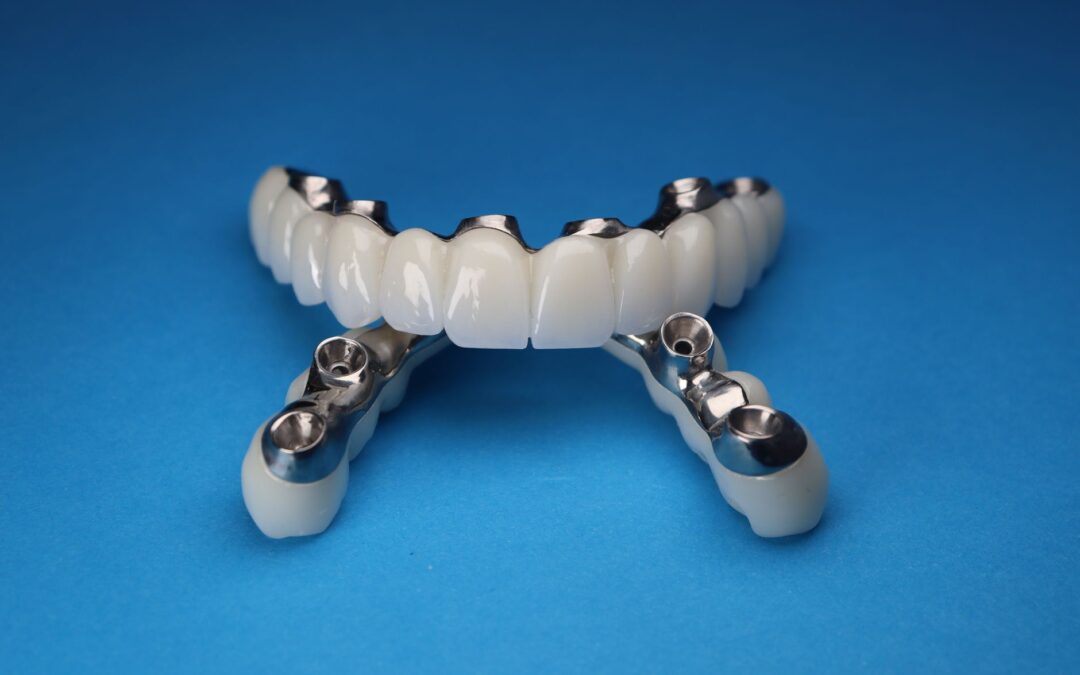
The cost of full mouth dental implants in the United States typically ranges from $20,000 to $90,000 or more, depending on how many implants you need, which type of restoration you choose, and where you’re treated. That’s a wide range, but once you understand the four or five factors that drive the number, your estimate narrows quickly and the sticker shock starts to make sense.
- Full-arch implant solutions (All-on-4, fixed bridges, implant-supported dentures) vary enormously in price because they are not one product — they are a multi-stage treatment plan with very different components.
- The number of implant posts, the material of the final restoration, the need for bone grafting, and your geographic area are the biggest price drivers.
- Bay Area prices generally run 15–30% above the national average, reflecting local lab, facility, and overhead costs.
- Most dental insurance provides limited help for implants, but third-party financing (CareCredit, Sunbit, in-office payment plans) can make large cases manageable.
- The cheapest quote isn’t always the best deal: the long-term cost of a restoration that fails, needs repair, or doesn’t fit well can far exceed the savings up front.
What exactly counts as “full mouth dental implants”?
This phrase gets used for several different treatments, and mixing them up is the number-one reason patients are confused by wildly different quotes. The main categories:
- All-on-4 (or All-on-6): A full arch of replacement teeth attached to four or six strategically angled implant posts. It is fixed (not removable) and can often be placed in a single surgical day with a temporary arch, replaced by the final restoration a few months later.
- Implant-supported overdenture (snap-in denture): Two to four implants act as anchors for a removable denture. Less costly than a fixed arch, but the denture still comes out for cleaning.
- Full-arch fixed bridge on multiple implants: Six to eight or more individual implants support a screw-retained or cemented bridge covering a complete arch. Often the most durable — and most expensive — option.
- Single-arch vs. full mouth: Some patients need work on one arch only (upper or lower); others need both. “Full mouth” sometimes means both arches, which roughly doubles the arch cost.
When you compare quotes, confirm which type of restoration each clinic is quoting, how many implant posts are included, and whether any bone grafting or extractions are bundled in. Comparing an All-on-4 quote to an eight-implant fixed-bridge quote is like comparing a studio apartment to a three-bedroom house. Same neighborhood, very different product.
What are the typical price ranges in 2026?
The figures below are national ballpark ranges only and do not represent Vaksman Dental Group’s prices. Fees vary by provider, region, complexity, and materials. Use these to calibrate — not to budget down to the dollar.
| Treatment Type | Per Arch (National Range) | Both Arches (National Range) |
|---|---|---|
| Implant-supported overdenture (2–4 implants) | $6,000 – $18,000 | $12,000 – $36,000 |
| All-on-4 / All-on-6 (fixed arch) | $15,000 – $30,000 | $25,000 – $55,000 |
| Full fixed bridge (6–8+ implants per arch) | $25,000 – $45,000 | $45,000 – $90,000+ |
In the San Francisco Bay Area, expect quotes at the higher end of each range or somewhat above it. That’s not price-gouging; it reflects higher costs for commercial space, dental lab fees, and staff salaries across the entire region.
What are the five main factors that move the price?
1. Number of implant posts
Each titanium post that gets surgically placed into your jawbone carries its own material and surgical fee. An All-on-4 uses four posts per arch; a full fixed bridge may use eight. More posts means more surgery time, more components, and a higher total. The upside of more posts is usually better long-term stability and load distribution — so this tradeoff is worth discussing with your dentist in detail.
2. The final restoration material
The teeth you actually see (the prosthetic arch or bridge) can be made from acrylic resin, zirconia, or porcelain-fused-to-zirconia, among other options. Zirconia restorations are typically more expensive — national average cost for a single implant crown in zirconia runs roughly $1,500–$3,000 per tooth according to available cost surveys — but they are also harder, more stain-resistant, and more natural-looking. Acrylic provisional arches cost less but are meant to be temporary.
3. Bone grafting and extractions
Implants need sufficient bone to anchor into. Patients who’ve been missing teeth for years, or who have had significant gum disease, sometimes need bone grafting before (or at the time of) implant placement. Grafting adds anywhere from a few hundred to several thousand dollars per site, and it can require a healing period that extends the overall treatment timeline. This is one of the most significant “hidden” cost variables — a quote that doesn’t include an exam and imaging first may be omitting this entirely.
4. Single-arch vs. both arches
If you need upper and lower arch reconstruction, you’re essentially looking at two treatment plans running in parallel or in sequence. Many practices do both arches in one surgical session to reduce total anesthesia time and recovery periods, but the fees do roughly double.
5. Geographic location and provider overhead
A university dental school program in a mid-sized Midwestern city will quote differently than a private specialist’s office in San Mateo County. Both can be excellent providers — but overhead, local labor, and commercial real estate costs flow through to the fee schedule everywhere in the country. The American Dental Association’s dental statistics resources confirm that regional fee variation is substantial and consistent.
Does dental insurance cover full mouth implants?
Honestly? Rarely in full, and often not at all for the implant portions. Most traditional dental insurance plans cap annual benefits at $1,000–$2,000 and classify implants as a “major” procedure subject to the annual maximum and waiting periods. Some plans offer partial coverage for the crown (the visible tooth portion) but nothing for the surgical placement of the post.
A few things worth knowing:
- If any teeth haven’t been extracted yet, your plan may cover extractions under a separate benefit.
- Bone grafting coverage varies widely — ask your insurer specifically.
- Some newer dental insurance products (particularly those sold through the ACA marketplace or employer add-ons) are beginning to include implant benefits, so it’s worth a careful read of your current plan’s “major restorative” section.
- Flexible Spending Accounts (FSAs) and Health Savings Accounts (HSAs) can be used for implant costs and are pre-tax, which effectively reduces the price by your marginal tax rate.
What financing options are typically available?
Because full mouth implant cases often run $20,000–$50,000 or more, most practices offer third-party financing in addition to in-house payment plans. Common options include:
- CareCredit: A healthcare credit card with promotional 0% APR periods (typically 12–24 months for qualifying purchases). Interest kicks in retroactively if the balance isn’t paid in full by the end of the promotional period, so read the fine print.
- Sunbit: A newer point-of-sale financing product used by many dental offices; approval rates tend to be higher than traditional credit cards and terms are straightforward.
- In-office installment plans: Some practices offer their own monthly payment arrangements, sometimes with no interest or a flat administrative fee.
- Personal loans or HELOCs: For large cases, some patients use personal loans from their bank or credit union, or a home equity line of credit, which may carry lower interest rates than healthcare-specific financing.
At Vaksman Dental Group, our team walks through financing and insurance options with you before any treatment begins — we want you to have a clear picture of what to expect, not a surprise bill.
Is a lower quote always a better deal?
Not necessarily, and this is worth saying clearly. A full-arch implant restoration is a long-term investment in your ability to eat, speak comfortably, and maintain jawbone density for years to come. Research in peer-reviewed implantology literature consistently shows that implant survival rates are strongly associated with proper patient selection, planning, surgical technique, and follow-up care — not just the upfront price.
A quote that looks $5,000–$10,000 cheaper may be omitting:
- A comprehensive exam and 3D cone-beam CT scan (necessary for safe implant planning)
- Bone grafting that will inevitably be needed once imaging is done
- The final restoration (quoting only the surgical phase)
- Follow-up and adjustment appointments
Ask any provider for an itemized treatment plan that specifies what’s included and what isn’t. A transparent practice will give you this without hesitation.
How do All-on-4 implants in South San Francisco compare to “dental tourism” options?
Dental tourism (traveling to Mexico, Eastern Europe, or other lower-cost countries for implant work) is a real option some patients pursue, and prices can be 50–70% lower. There are legitimate providers doing good work in those markets. But there are real considerations specific to multi-stage, full-arch implant cases:
- Full-arch implant treatment involves multiple appointments over several months (surgical placement, healing, impressions, final restoration fitting). Coordinating this across international travel is genuinely complicated.
- If a complication arises — infection, implant failure, a poorly fitting restoration — the follow-up care falls to a local dentist who didn’t place the implants and may have limited records or access to the original components.
- Implant component brands matter: some lower-cost providers use implant systems that aren’t widely stocked in U.S. dental offices, making future repairs or replacements difficult.
This isn’t an argument against dental tourism in all cases — it’s an argument for going in with a clear-eyed view of the tradeoffs, not just the price difference.
What’s the process like, start to finish?
Understanding the sequence helps you see why the cost is what it is. A typical full-arch implant journey looks roughly like this:
- Comprehensive exam and 3D imaging (cone-beam CT): Your dentist maps your bone volume, nerve locations, and sinus anatomy before any plan is made. No responsible provider skips this step.
- Treatment planning and case design: The number of posts, their positions, and the final restoration type are all decided here. This is where a well-equipped office — one that uses digital planning software, surgical guides, and in-house fabrication tools — can produce a more precise and predictable outcome.
- Extractions (if needed): Any remaining compromised teeth are removed, sometimes at the same appointment as implant placement.
- Bone grafting (if needed): Grafting material is placed and allowed to integrate, which may require weeks to months before implants can be placed.
- Implant surgical placement: Titanium posts are placed under local anesthetic (and sedation if preferred). A temporary restoration is often placed the same day.
- Osseointegration: Over three to six months, bone grows around and fuses to the implant posts — a process called osseointegration. This is the biological core of why implants are so durable.
- Final restoration: Impressions (or digital scans) are taken and the final prosthetic arch is fabricated and attached. Adjustments are made to ensure proper bite, fit, and comfort.
- Ongoing maintenance: Implants don’t decay, but the gum tissue and bone around them need regular professional cleaning. Annual check-ups and periodic imaging are standard.
At our South San Francisco office, we use All-on-4 dental implants in South San Francisco as part of our full-arch restoration options. Our team also uses in-office dental crown fabrication via CEREC for certain single-tooth implant restorations, which can reduce the number of appointments and eliminate the need for a temporary crown. And for patients who benefit from guided surgery, our SprintRay 3D printer allows us to produce precise surgical guides in-house.
When should I get a consultation vs. waiting?
If you’re missing multiple teeth or wearing a full denture that fits poorly, sooner is usually better. Bone resorption (the gradual shrinkage of the jawbone that happens after tooth loss) is ongoing and progressive. The longer implant placement is delayed, the more bone may be lost — and the more extensive (and costly) grafting may become. A consultation doesn’t commit you to anything; it gives you a real picture of where you stand.
If cost is a barrier right now, ask about phasing: some practices can place the implants in one phase and complete the final restoration in a later phase as finances allow. It’s not always possible, but it’s worth asking.
Frequently Asked Questions
How much do full mouth dental implants cost compared to dentures?
Traditional dentures are significantly less expensive upfront, typically $1,000–$5,000 for a full set depending on material and fit. Full-arch implant solutions start around $15,000–$30,000 per arch and go up from there. However, dentures require periodic relining, replacement every 5–10 years, and do not prevent bone loss the way implants do. Over a 20-year period, the lifetime cost difference narrows, and the functional and quality-of-life differences are substantial. The right choice depends on your bone health, overall health, and priorities — which is a conversation worth having with your dentist.
Are full mouth dental implants covered by Medicare or Medi-Cal?
Traditional Medicare (Parts A and B) does not cover dental implants as of 2026. Some Medicare Advantage (Part C) plans include limited dental benefits that may partially cover implant-related procedures — check your specific plan’s “supplemental dental” section carefully. Medi-Cal covers emergency dental services for adults and some basic restorative care, but full implant reconstruction is generally not a covered benefit under standard Medi-Cal dental. Rules do change, so it’s worth a direct call to your insurer or benefits coordinator.
How long do full mouth implants last?
Implant posts (the titanium anchors in the bone) have very high long-term survival rates. Studies consistently report 95%+ survival at 10 years for properly placed implants in healthy patients. The prosthetic restoration (the teeth you see) may require adjustment, repair, or replacement over time — acrylic or hybrid restorations typically need attention every 10–15 years; zirconia tends to be more durable. Good home care and regular professional cleaning are the biggest factors in long-term success.
What’s the difference between All-on-4 and full fixed bridge implants?
Both are fixed (non-removable) full-arch solutions, but they differ in the number of implants supporting the arch and, often, the material and construction of the final prosthetic. All-on-4 uses four strategically angled implants per arch, which works well for patients with some bone loss because the posterior implants are tilted to avoid sinus and nerve anatomy. A full fixed bridge on six or more implants distributes bite force across more support points and may be preferred for patients with sufficient bone who want maximum load-bearing capacity. Neither is universally “better” — the right option depends on your bone anatomy, bite force, and your dentist’s clinical assessment.
If you’re in the South San Francisco area and want a real, no-obligation picture of what full-arch implant treatment might look like for your situation, our team is happy to walk you through it. A consultation includes a clinical exam and a candid conversation about options, timing, and costs — no pressure, just information.
You can also explore more about our dental implants in South San Francisco to learn how our office approaches single-tooth and full-arch cases.
Written by the Vaksman Dental Group team and medically reviewed by Dr. Irena Vaksman, DDS — South San Francisco. Last reviewed August 2026.