
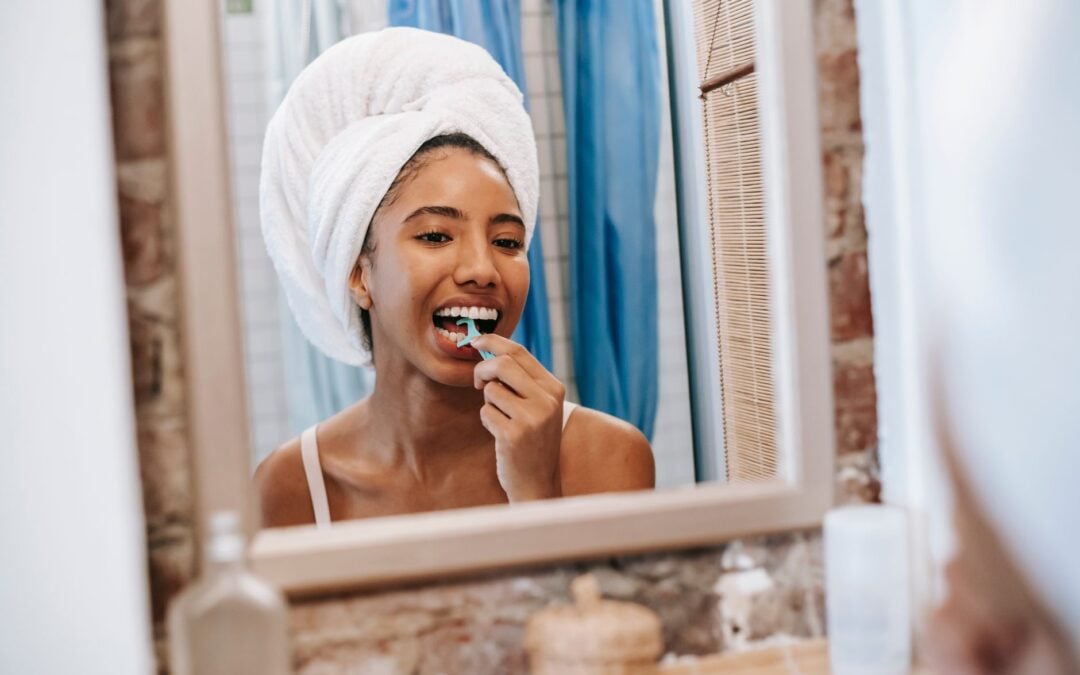
Some popular dental flosses contain PFAS — a class of synthetic chemicals linked to health concerns — and a study published in The Washington Post recently brought this back into the news cycle. The good news: flossing is still one of the most important things you can do for your gum health, and switching to a lower-risk floss is straightforward once you know what to look for.
- Some conventional dental flosses, especially those marketed as “glide” or “smooth,” may contain PFAS (per- and polyfluoroalkyl substances) used as a coating to reduce friction.
- Research suggests regular use of certain flosses may be associated with elevated PFAS levels in the bloodstream, though more study is needed to establish direct health effects.
- Switching to a PFAS-free or natural fiber floss is easy and still gives you the same gum-health benefits.
- Flossing itself is not the problem — it remains a cornerstone of cavity and gum disease prevention. The goal is to floss smarter, not less.
- Your dental team can recommend the right floss for your teeth and gums at your next cleaning and exam appointment.
What exactly are PFAS, and why are they in dental floss at all?
PFAS stands for per- and polyfluoroalkyl substances. There are thousands of individual compounds in this family, and they share one quality that makes them so useful in manufacturing: they are extremely slippery and resistant to heat, water, and oil. That same slipperiness is what makes certain flosses glide easily between tight contact points.
Manufacturers coat the floss fibers with a PFAS-based compound so the strand slides between teeth without shredding. For years this was considered an unremarkable industrial choice. The concern that has emerged is that PFAS compounds do not break down easily in the body or the environment, which is why researchers started calling them “forever chemicals.” Studies have begun to examine whether using PFAS-coated floss repeatedly — day after day, year after year — could contribute to measurable PFAS levels in the blood.
According to research covered by the National Institute of Environmental Health Sciences (NIEHS), some PFAS compounds have been associated in human studies with effects on hormones, immune function, and cholesterol levels. That research is ongoing, and cause-and-effect in humans has not been fully established for floss-specific exposure levels. But “ongoing research” does not mean “ignore it” — it means make a straightforward, low-effort swap if you can.
Which flosses are most likely to contain PFAS?
The 2019 Silent Spring Institute study that first raised this question found elevated PFAS most often in flosses marketed with terms like “glide,” “smooth,” or “comfort.” Oral-B Glide was among the products tested. Not every floss on the shelf has the same coating, and many conventional waxed flosses use a simple wax rather than a fluoropolymer coating.
A few useful rules of thumb:
- Look at the material. Flosses made from polytetrafluoroethylene (PTFE) — the same material as non-stick cookware — are the most likely to contain fluoropolymer coatings. The ingredient list or marketing copy often says “PTFE” or just “glide.”
- Waxed nylon flosses typically use a simple beeswax or synthetic wax coating and are generally considered a lower-concern option.
- Natural fiber options — silk floss, bamboo floss, and plant-based flosses — avoid synthetic coatings altogether and have become widely available at regular drugstores and grocery stores.
- Water flossers use no fiber or coating at all, making them a solid option for people with tight contacts, braces, bridges, or implants.
No regulatory body has yet mandated PFAS testing on dental floss packaging, so you are largely relying on the material description rather than a certified label. When in doubt, a simple waxed nylon floss or a natural fiber alternative gets the job done.
Should you stop flossing because of this?
No. This is the most important thing to take away from this conversation. The American Dental Association (ADA) on MouthHealthy.org is clear that cleaning between your teeth daily is essential for removing the plaque and food debris that a toothbrush simply cannot reach. Skipping flossing altogether would very likely cause more measurable harm — through cavities between teeth and gum disease — than any realistic risk from floss coatings.
Think of it this way: the goal here is to floss with a better product, not to stop flossing. Gum disease is a genuine, well-documented risk to your teeth and your systemic health. Switching your floss brand is a five-minute errand. One choice is clearly easier than the other.
What about floss picks, water flossers, and interdental brushes?
These are all legitimate alternatives, and some people find them easier to use consistently than traditional string floss.
Floss picks use a short strand of floss on a plastic handle. They are convenient, but they carry the same coating considerations as the floss they are made from. Check what type of strand the pick uses — many are PTFE-based for the same smooth-glide reason.
Water flossers (like Waterpik-style devices) use a pressurized stream of water to clean between teeth and along the gumline. Studies show they can be as effective as string floss for reducing gingivitis, and they contain no fiber or chemical coating at all. They are especially useful if you have tight contacts that shred conventional floss, Invisalign aligners, or dental bridges where threading floss is awkward.
Interdental brushes — small bristled picks that fit between teeth — are another option, particularly for people with wider gaps or exposed root surfaces. These have no coating concerns either.
The best interdental cleaning tool is, honestly, the one you will actually use every day. Our dental team is happy to talk through the options at your next visit to help you find a routine that sticks.
How do I read a floss label to find a PFAS-free option?
Packaging is not always transparent, but here is a quick checklist to use at the store:
- Scan for “PTFE” or “polytetrafluoroethylene.” If you see it, that product likely has a fluoropolymer coating.
- Look for “waxed nylon.” Nylon with a simple wax coating is the classic, widely-available, lower-concern option.
- Check for “PFAS-free” claims. A growing number of brands now advertise this directly. Examples include flosses made from silk, bamboo, or plant-based fibers sold by smaller specialty brands — but mainstream brands are beginning to follow.
- Consider a water flosser. No label required; no coating at all.
You do not need to spend a lot of money. A standard waxed nylon floss from any drugstore in South San Francisco is a perfectly solid, low-cost choice.
Does this affect how often I should see my dentist?
Not directly — but this story is a good reminder that your home oral care routine and your in-office care work together. Flossing at home removes the soft plaque between teeth that hardens into tartar if left too long. Once tartar forms, only a professional cleaning can remove it. Seeing your dental team for regular dental cleanings and exams in South San Francisco is how problems get caught early before they grow into something more involved.
At our office on Mission Road, our hygienists are also a great resource for personalized flossing advice — what type of floss or tool fits your anatomy, how to handle tight contacts, and how to make the habit stick. That kind of one-on-one guidance is something no product label can replicate.
What is the bottom line on floss safety right now?
The research on PFAS in floss is real and worth paying attention to, but it does not warrant alarm or ditching flossing. The practical takeaway is simple: if your current floss is a PTFE “glide” style, consider swapping to a waxed nylon floss, a natural fiber floss, or a water flosser. Make the switch next time you run out. That is genuinely all that is required.
As with most things in oral health, small, consistent habits make the biggest difference over time. Floss daily, choose a product you are comfortable with, and see your dentist regularly. Those three steps cover the vast majority of what you need to protect your teeth and gums for the long haul.
Frequently Asked Questions
Is all dental floss contaminated with PFAS?
No. PFAS-based coatings are primarily found in flosses that use PTFE (polytetrafluoroethylene) for a smooth glide feel. Standard waxed nylon flosses and natural fiber flosses (silk, bamboo) typically do not use fluoropolymer coatings. Water flossers contain no fiber or coating at all.
How much PFAS exposure does flossing actually cause?
The Silent Spring Institute study found that women who used certain PTFE-based flosses had measurably higher blood levels of a specific PFAS compound compared to non-users. However, the absolute exposure level from flossing is much lower than from other sources like food packaging or cookware, and researchers have not established a direct health harm from floss-specific PFAS exposure. The precautionary step of switching products is low-effort and reasonable.
Can I just use a water flosser instead of string floss?
Yes. Research published in peer-reviewed journals shows that water flossers can be as effective as string floss at reducing gingivitis and removing debris between teeth when used properly. They are an especially good choice for people with dental bridges, implants, or orthodontic appliances. Ask your dental team whether it makes sense for your specific situation.
Should I be worried if I have been using Oral-B Glide or a similar floss for years?
This is a reasonable question, and the honest answer is that there is no established evidence of specific harm from years of flossing with a PTFE-coated product. The research flags an association with elevated PFAS blood levels, not a documented disease outcome tied to floss use specifically. If you are concerned, mention it at your next dental visit. Switching to a different floss going forward is the practical step most experts recommend.
Schedule a Cleaning and Ask Us About Your Flossing Routine
Written by the Vaksman Dental Group team and medically reviewed by Dr. Irena Vaksman, DDS — South San Francisco. Last reviewed October 2026.