
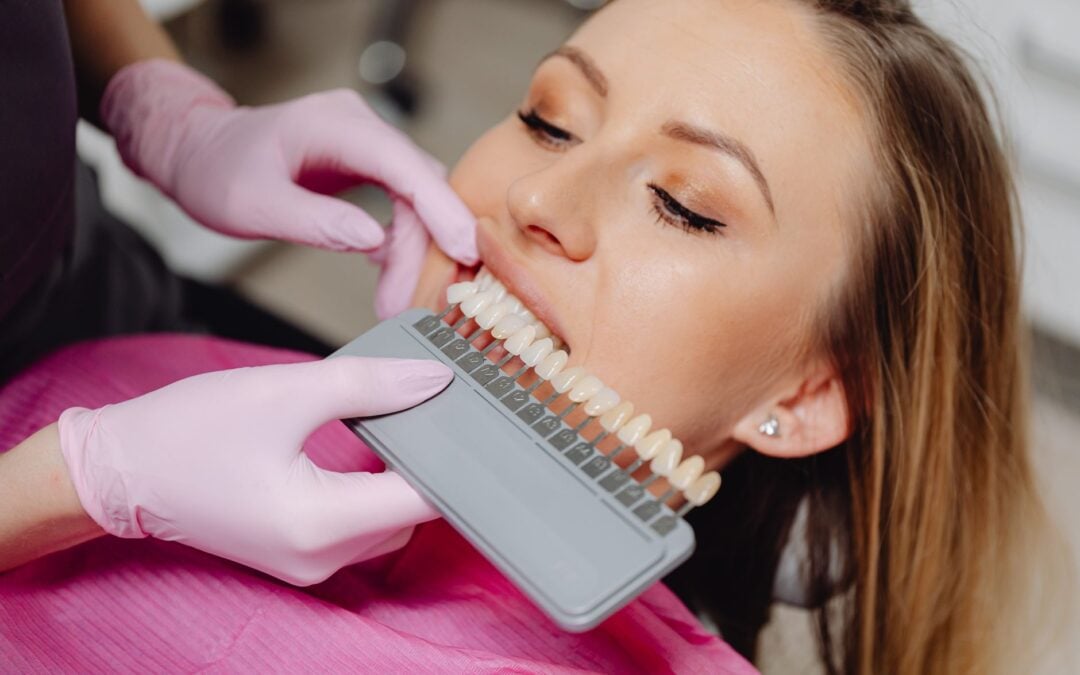
Jo Koy’s smile has been hard to miss lately. The comedian and Netflix star showed up to recent appearances with noticeably brighter, more uniform teeth, and search traffic for “Jo Koy teeth before and after” spiked almost immediately. People are curious. And honestly, that curiosity usually leads to a genuinely useful question: could veneers work for me?
We can’t speak to Jo Koy’s specific dental records or treatment (no dentist ethically can), but his transformation is a great jumping-off point for the questions patients at our South San Francisco office ask us most often about veneers. Here’s what our dental team actually hears, and what you should know.
What did Jo Koy’s teeth look like before, and what changed?
Based on widely available photos over the years, Jo Koy’s natural smile had slightly uneven spacing, some discoloration, and teeth that varied a bit in shape and length. His more recent appearances show a noticeably whiter, more symmetrical smile with consistent tooth shape from front to back.
That kind of change is the fingerprint of porcelain veneers, possibly combined with some whitening. Veneers are thin ceramic shells bonded to the front surface of your teeth. They can address color, shape, length, and minor alignment issues all at once, without moving teeth the way braces do. The result, when done well, looks like a natural smile that simply improved, not a “fake” Hollywood look.
What’s notable about his transformation is that it doesn’t look overdone. The teeth aren’t disturbingly uniform or blindingly white. That restraint actually reflects good cosmetic dentistry, where the goal is a smile that fits your face.
How many veneers do you need to get a result like that?
It depends on what you’re starting with. Most smile makeovers that visibly change the front of the smile involve anywhere from 6 to 10 veneers, covering the teeth that show when you smile fully. Some people do just 4 on the upper front teeth; others go wider for a more comprehensive change.
A common mistake patients make is assuming they need to veneer every visible tooth, or that fewer veneers means a lesser result. Our dentists look at your natural bite, your face shape, and what’s actually visible when you smile at rest versus when you’re laughing. The goal is to figure out the minimum number of veneers that gives you the maximum improvement, because every veneer is a permanent commitment.
For a result like Jo Koy’s, covering most of the visible upper (and possibly lower) teeth with porcelain, you’re likely looking at 8 to 12 veneers total. But that number is very individual.
Do veneers hurt? What’s the procedure actually like?
This is one of the questions we hear most often, and the honest answer is: it’s more involved than most people expect, but it’s not the ordeal some fear.
Traditional porcelain veneers require a small amount of enamel to be removed from the front of the tooth before the veneer is placed. This is permanent, which is the main reason we take the preparation step seriously. Local anesthesia is used, so you shouldn’t feel pain during the procedure. Some patients experience sensitivity for a few days afterward, especially to temperature, but this typically settles down once the permanent veneers are cemented.
The classic process takes two appointments spread over a week or two: one to prepare the teeth and place temporary veneers, and a second to bond the permanent porcelain shells. In some cases, dental veneers can be planned digitally so you can preview your result before anything is finalized, which patients tend to love.
If enamel removal is a concern, ask your dentist about prepless or minimal-prep veneers. These require little to no enamel reduction, though they’re only appropriate for certain tooth shapes and bite situations.
How much do veneers cost? Can I afford what Jo Koy probably got?
Celebrity smile makeovers can run anywhere from $20,000 to $60,000 or more for a full set, depending on the dentist, the location, and the number of teeth involved. That’s not a realistic benchmark for most people.
Nationally, porcelain veneers typically range from roughly $900 to $2,500 per tooth (these are general ballpark figures, not our office’s prices). A set of 8 upper veneers could fall anywhere from $8,000 to $20,000 depending on the provider and materials. In the San Francisco Bay Area, costs tend to be toward the higher end of national ranges.
A few things actually drive the price:
- Number of veneers: More teeth covered means a higher total cost.
- Material: Feldspathic porcelain, eMax (lithium disilicate), and zirconia all look and perform differently, and are priced differently.
- Dental lab vs. in-office fabrication: Some offices fabricate restorations in-house, which can affect turnaround and sometimes cost.
- Any preparatory work needed: If you need gum contouring or treatment for gum disease before veneers, that adds to the total.
Dental insurance typically does not cover veneers, since they’re classified as cosmetic. However, many offices offer financing, so ask about payment plans when you consult.
Are veneers bad for your teeth long-term?
This is a fair concern, and the answer is nuanced. Veneers done correctly by an experienced dentist are not inherently damaging. But because traditional veneers require removing a thin layer of enamel, the tooth is permanently altered. You will always need veneers or some type of coverage on that tooth going forward.
According to research, porcelain veneers have a solid long-term track record. A widely cited study in the International Journal of Prosthodontics found survival rates above 90% at 10 years for feldspathic porcelain veneers with good patient compliance. Modern ceramic materials have improved significantly since then.
The risks that do exist usually come from:
- Grinding or clenching (bruxism) putting excessive force on veneers
- Poor oral hygiene leading to decay at the margins
- Choosing a provider without sufficient cosmetic experience
- Trying to use veneers to fix alignment issues better addressed by orthodontics
If you grind your teeth at night, our team typically recommends a night guard to protect your investment. That’s not a reason to skip veneers, it’s just part of a complete plan.
Is there anything that should be fixed before getting veneers?
Yes, and this is something we want every patient to understand before sitting down for a cosmetic consultation. Veneers go on top of your existing teeth. Any underlying problems, whether that’s gum disease, active cavities, or significant bite issues, need to be resolved first. Placing beautiful porcelain over an unhealthy tooth is like painting over rot.
At our office, a cosmetic consultation always starts with a full assessment of your oral health baseline. If there’s gum disease treatment in South San Francisco that needs to happen first, we’ll walk you through that sequence clearly. Rushed cosmetic work that skips the health foundation is one of the most common reasons people end up disappointed with their results later.
The American Dental Association’s MouthHealthy resource on veneers echoes this: veneers are a great tool in the right situation, but they’re not a shortcut around foundational oral health.
How do I know if veneers are actually right for me, or if I should look at other options?
Veneers are excellent for certain things: permanent staining that doesn’t respond to whitening (like from tetracycline or old trauma), chipped or slightly misshapen teeth, and closing small gaps. They’re less ideal as a standalone fix for significant crowding or bite problems, where orthodontics might serve you far better.
Here’s a quick mental framework:
- Your teeth are healthy but discolored: Professional whitening first; veneers if whitening won’t get you there.
- Your teeth are crooked or crowded: Orthodontics (like Invisalign) first; veneers can refine the result after.
- Your teeth are chipped, short, or worn: Veneers are often the most efficient solution.
- You have one or two problem teeth: cosmetic dental bonding may be a more conservative and affordable option worth exploring.
The best answer is one your dentist gives you after actually looking at your teeth, your bite, your goals, and your overall oral health. A cosmetic consultation is exactly that: a conversation about what’s possible, what’s realistic, and what fits your life.
Curious whether veneers are the right move for your smile? Our team at Vaksman Dental Group in South San Francisco is happy to walk you through your options, no pressure, no guesswork.
Written by the Vaksman Dental Group team and medically reviewed by Dr. Irena Vaksman, DDS — South San Francisco. Last reviewed September 2026.