
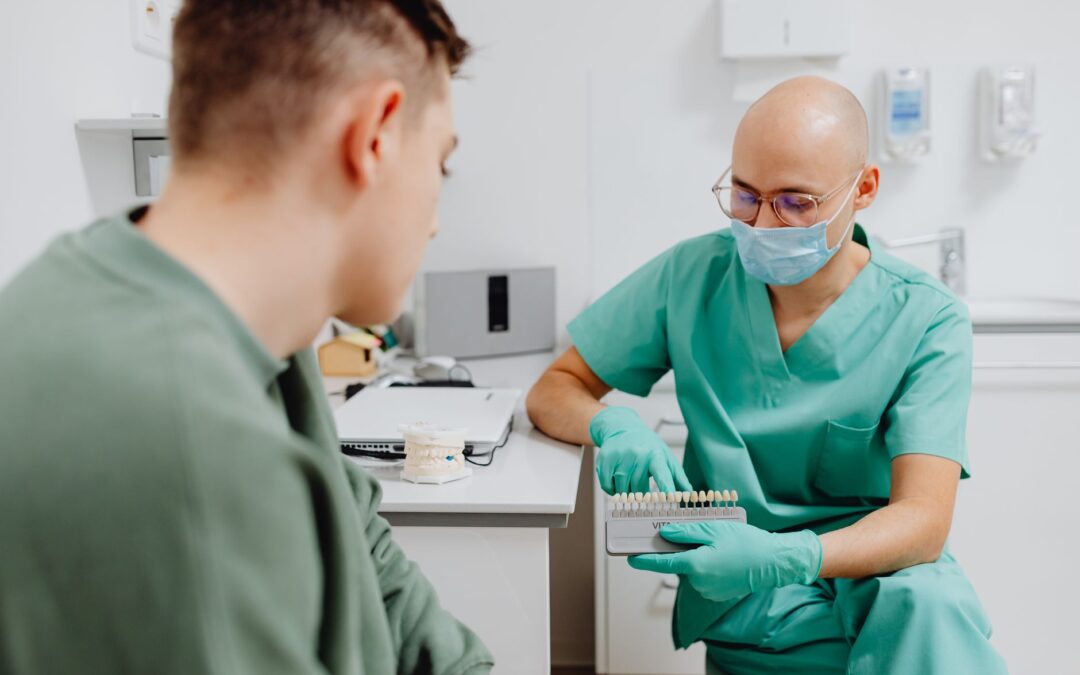
People get veneers for one straightforward reason: they want a smile they feel good about, and their teeth aren’t getting them there on their own. Veneers are thin shells of porcelain (or composite resin) that bond to the front surface of teeth, covering a wide range of cosmetic concerns in one go. But the specific “why” varies a lot from person to person. Here are the seven most common reasons patients walk into a dental office asking about them.
1. Permanent Staining That Whitening Can’t Touch
Regular teeth whitening works well for surface stains from coffee, tea, or wine. But some discoloration lives inside the tooth itself, and no bleaching gel reaches it.
Tetracycline antibiotics (taken in childhood, sometimes even before birth) can cause deep gray or brown banding. Fluorosis from too much fluoride during tooth development can leave white spots or brown patches. A tooth that suffered trauma may darken over time as the nerve slowly breaks down inside.
Veneers sidestep the problem entirely. Because they cover the front face of the tooth with a uniform, color-matched shell, intrinsic stains simply disappear from view. That’s a genuinely different solution from whitening, not a better version of it.
The American Dental Association’s MouthHealthy resource on veneers notes that they are one of the few cosmetic options that can address staining that whitening cannot correct.
2. Chipped or Worn-Down Teeth
Teeth take a lot of abuse over a lifetime. Biting nails, grinding at night, or just decades of use can chip edges, flatten cusps, and shorten teeth that once looked full and healthy.
A small chip is easy to dismiss, but it often becomes the thing a person notices every time they smile in a photo. Composite bonding can repair a single chip quickly and affordably. But when multiple teeth are affected, or when the wear is more extensive, veneers give a more durable, uniform result across the whole smile zone.
Worth noting: if teeth grinding (bruxism) is the underlying cause, a dental mouth guard should be part of the plan alongside veneers. Skipping that step puts the restorations at risk.
3. Gaps Between Teeth
A gap between the two front teeth (a diastema) is one of the most searched cosmetic dental concerns on the internet. Some people love theirs. Some find it charming. And some have wanted it closed since middle school.
Veneers can close small to moderate gaps by making the teeth slightly wider on each side. It is a faster path than orthodontics for purely cosmetic gaps, though the dentist needs to assess whether the gap is small enough that the resulting tooth width will still look natural. A very wide gap may need Invisalign or braces first.
Patients who come in asking about gaps often leave with a conversation about two or three options. That kind of honest comparison matters.
4. Mild Crowding or Uneven Teeth (When Orthodontics Isn’t the Goal)
Veneers can create the appearance of straighter teeth without moving them. This is sometimes called “instant orthodontics,” though that phrase oversimplifies things a bit.
Here is the honest version: veneers work well for minor overlaps, slight rotations, or teeth that are noticeably shorter or longer than their neighbors. They do not move teeth, so they do not change your bite. For anything beyond mild irregularity, orthodontic treatment is the more appropriate solution because it actually corrects the position rather than masking it.
Our dental team at Vaksman Dental Group will tell you clearly which approach fits your situation. If Invisalign in South San Francisco is the better answer, we will say so.
5. Misshapen or Unusually Small Teeth
Some teeth are just shaped differently. Peg laterals (the incisors on either side of the front teeth that are naturally smaller and more pointed than average) are a common one. Others have teeth with uneven edges, a notch from an old chip that never got fixed, or a tooth that is simply narrower than it should be relative to its neighbors.
Veneers rebuild shape predictably and durably. Because porcelain can be crafted to precise dimensions, the result looks like the tooth that was always supposed to be there. For peg laterals especially, a veneer or crown is typically the only cosmetic fix that gives a lasting, natural-looking result.
6. A Complete Smile Refresh (Multiple Concerns at Once)
Sometimes it is not one thing. It is the staining AND the chip AND the slight gap AND the fact that the teeth just look smaller than they used to. Several small issues together can make a smile feel tired or aged in a way that no single treatment addresses.
This is the scenario where a full set of veneers (typically 6 to 10 covering the visible smile zone) makes the most sense as part of a broader cosmetic dentistry plan in South San Francisco. The dentist treats the whole smile as a unit rather than patching individual problems one by one. The result tends to look more cohesive than fixing each tooth in isolation over the years.
A thorough consultation that includes photos, shade matching, and sometimes a digital or wax mock-up preview is the right way to plan this kind of work.
7. Confidence (the Reason Behind the Reason)
This one is less clinical and more honest. For a lot of patients, the reason they finally book the consultation is not a clinical diagnosis. It is that they have been covering their mouth in photos for years. Or they stopped smiling with their teeth at some point and cannot remember when. Or they have a big life event coming up and want to feel like themselves again.
That is a completely legitimate reason to explore veneers. Cosmetic dentistry does not fix problems that only a dentist can see. It addresses things that affect how a person moves through the world.
Research published in the Journal of Prosthodontic Research (via NIH) has found associations between dental appearance and quality of life measures including social confidence and willingness to smile. That is not a trivial outcome.
What Veneers Cannot Do (Equally Important)
Veneers are a cosmetic solution, not a structural one. They do not fix decay, gum disease, or significant bite problems. Any underlying health issues need to be treated first. They also require removing a small, permanent amount of enamel in most cases, which means the commitment is lifelong. And they typically need replacement every 10 to 20 years depending on the material and how well they are cared for.
The consultation appointment exists precisely to work through these trade-offs, not to sell you something.
The Bottom Line
People get veneers because they have a specific problem (or several) that other treatments cannot solve as cleanly, or because they want a total smile reset and veneers are the most efficient path to it. The best candidates have realistic expectations, healthy gums and teeth underneath, and a clear picture of what they want to change. A good consultation will tell you quickly whether veneers are the right tool or whether something else fits better.
Frequently Asked Questions
Are veneers permanent?
Veneers themselves are not permanent in the sense that they last forever. Most porcelain veneers last 10 to 20 years before needing replacement. However, the process of placing them involves removing a thin layer of enamel, which cannot be reversed. So the commitment to having veneers (or some type of restoration on those teeth) is permanent.
Do veneers look fake?
Well-made porcelain veneers are designed to mimic the translucency and texture of natural tooth enamel. When shade and shape are chosen carefully during the consultation, the result looks like a naturally great smile rather than an obvious cosmetic procedure. Composite veneers tend to look less translucent and may stain over time.
Can you get veneers on just one tooth?
Yes. A single veneer on one tooth is common, especially for a chipped, discolored, or misshapen tooth. The main challenge is matching the shade precisely to the surrounding teeth. A skilled dental team can do this well, though the match may not be perfect if the neighboring teeth are very distinctively colored or translucent.
How do I know if I’m a good candidate for veneers?
Good candidates generally have healthy gums and enough existing enamel for the veneer to bond to, realistic expectations about what veneers can and cannot fix, and no active bite or grinding issues (or those issues are being managed). The only way to know for certain is a consultation with your dentist, who can evaluate your teeth, gums, and bite before making a recommendation.
Ready to find out if veneers are the right fit for your smile? Our team in South San Francisco is happy to walk you through your options with zero pressure.
Written by the Vaksman Dental Group team and medically reviewed by Dr. Irena Vaksman, DDS — South San Francisco. Last reviewed July 2026.